[ Getting Found ]
Website Not Showing Up on Google?

[ Getting Found ]
A website not coming up on Google search has one of exactly three causes: Google has not indexed it yet, something is blocking Google from seeing it, or it is indexed but outranked so deeply that nobody scrolls to it. Ten minutes and three free checks will tell you which one is yours. This article walks through all three, then the newer fourth problem: being visible on Google but invisible to the AI assistants your customers have started asking instead.
The stakes are bigger here than almost anywhere else you could spend an afternoon. Statcounter's July 2026 data puts Google at 88.22% of Australian searches, with Bing a distant second at 8.74%. For roughly nine in every ten of your potential customers, if Google cannot see you, you do not exist.
Go to Google and search site:yourwebsite.com.au with your real address and no spaces. This lists every page of your site that Google holds in its index. If your pages appear, you are indexed and your real problem is ranking, so skip to Check 3. If nothing appears, Google does not have your site, and that is the whole problem.
New sites and new pages take days to weeks to be picked up, and there is no queue you can pay to jump. Google's own Search Essentials documentation puts it plainly: Google "doesn't guarantee that it will crawl, index, or serve your page". What you can do is make indexing easy. Set up Google Search Console, free and from Google itself, submit your sitemap, and request indexing on your key pages. Every site I build has this done before launch day, because a website Google cannot see is a brochure in a locked drawer.
Still not indexed after several weeks? Something may be telling Google to stay out. Three usual suspects account for almost every case I have seen:
Search Console names the culprit for you: its Pages report shows which pages Google saw and why it skipped them. This is the least common of the three problems and the most maddening, because the site looks perfectly healthy to you while being invisible to every crawler on earth.
This is most small businesses' real situation. Open a private browsing window, so your own history does not flatter you, and search what a new customer would actually type: your service plus your town. Not your business name. The people who already know your name were never the problem. If competitors fill the map pack and the first page while you sit on page four, you are indexed, blocked by nothing, and simply out-earned by the sites above you.
The cost of that position compounds quietly. Run your own numbers: a service searched 300 times a month in your area is roughly 3,600 searches a year. Sitting where nobody scrolls means close to none of them find you, and if even 2% would have enquired, that is around 72 enquiries a year going to whoever holds page one. Outranked is not fixed with a trick; it is out-earned over months with service pages that answer what locals type, a Google Business Profile that is complete and active rather than claimed and abandoned, and reviews arriving steadily. That compounding work is what my organic growth partnership does month after month, and if you want the full picture of how the whole results page is won, my plain English guide to search engine marketing maps every region of it.
| Symptom | Likely cause | Free check | The fix |
|---|---|---|---|
| Nothing appears for site:yourdomain | Not indexed yet | site: search on Google | Search Console, submit sitemap, request indexing |
| Still nothing weeks later | Blocked: robots.txt, noindex, builder setting | Search Console Pages report | Remove the blocker, request indexing again |
| Found for your name, invisible for your service | Indexed but outranked | Private-window search: service + town | Months of earned work: pages, profile, reviews |
| On Google but never named by AI assistants | Weak AI-readable signals | Ask ChatGPT who to call for your trade in your town | Consistent details, structured data, quotable answers |
Here is the wrinkle that did not exist when most advice on this topic was written. A growing share of customers skip the results page entirely and ask ChatGPT or Google's AI who to call, and the answer reads out one or two names. That channel is not a novelty: HubSpot's January 2026 research found its AI-referred leads converted 3 times better than average. You can rank respectably on classic Google and still never be a name the assistants say, because they weigh signals many websites neglect: identical business details everywhere you appear, structured data underneath your pages, real reviews, and content written clearly enough to quote.
Test it in two minutes, and brace yourself: ask ChatGPT who to call for your trade in your town, and see whether you are named. Being findable in 2026 means being findable in both systems at once.
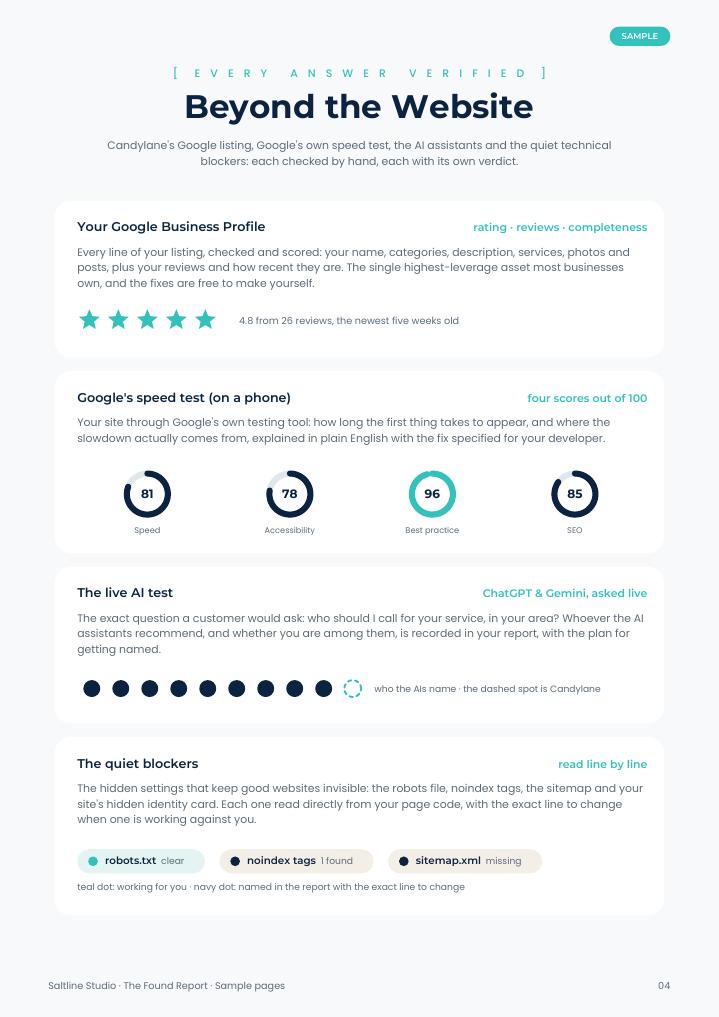
The three checks above cost nothing and I would start there today. If you want the complete picture instead of a hunch, that is the exact job of The Found Report: your homepage and key money pages checked one by one, your Google Business Profile scored, your socials, your speed, and live AI tests recording whether ChatGPT and Gemini recommend you. A score out of 100, a fix for every finding, $550 flat, delivered in five business days. Or begin with the free Found Score: ten questions, two minutes, no email required. And if you are weighing whether professional search help is worth paying for at all, I have written an honest answer to that question too, including when it is not.

Founder & digital marketing specialist at Saltline Studio, Port Macquarie. Helping small businesses grow with custom websites and organic search.